
MaineSwedishColony.info makes connections between organizations, schools, and individuals in the community and promotes community cultural development. Maine Swedish Colony is a historical designation for the region in Aroostook County, Maine, that is loosely defined by the towns of New Sweden, Stockholm, Woodland, Connor, Perham, Westmanland, Madawaska Lake, and Caribou.
116 Station Road
PO Box 33
New Sweden, ME, 04762
207-896-5200
newswedenmehistorical@gmail.com
280 Main Street
Stockholm, ME 04783
Sandra Hara
1149 New Sweden Rd.
Woodland, ME 04736
As the New Sweden Colony filled upwith immigrants from 1870 on, there was a need for more land, so a strip of T15-R4 on the western boundary of New Sweden was opened to settlement. The State of Maine had deeded the east half of T15-R4 to Fryeburg Academy in 1850, except for 500 acres reserved for public uses ("school land"). Fryeburg Academy in turn sold their land to various land owners, who then sold to the new Swedish immigrants.
In 1879 the first group of immigrants to settle in T15-R4 included Carl
Gustaf Persson/Petterson/Peterson with wife Carolina and seven children:
Carl August, Gustaf Emil, Theodore, Hilma Maria, Johanna Axelina (all of
whom took the surname Carlsson/Carlson according to the old Swedish naming
pattern), Hilda (with husband Emil Jansson/Johnson and son Oscar) and Augusta
(with husband Adolph Anderson and children Linus and Elin.) Arriving at
the same time were Carl Frederick Petterson/Peterson with wife Ida and
son Emil, who stayed a short while on the Lebanon Road in New Sweden (with
Carl's sister Augusta and her husband Frederick Anderson), before clearing
their land and settling in what at first was called "Academy". They were
reunited with Carl G.'s daughter Annie who came with her aunt Augusta in
1871.
In 1880 Nels and Louisa Swenson arrived with their three children Hedda,
Erick and Axel. They changed their name to Wedberg after Nels died in 1894.
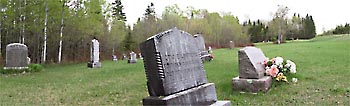
All of these earliest immigrants settled on the northerly end of Westmanland
Road.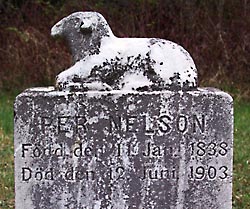
The southerly end of the road was first settled in 1881 by Victor Lindberg
who came from Västmanland, Sweden. He is credited with naming
the new plantation Westmanland when it was organized June 1, 1892. Many
other families followed the Lindbergs in settling this area, including
several children of his brother (Lars Eric Olson Latt): Victor Latt, Carl
Ulric Latt (who married Emma Lindberg), Carolina Wilhelmina Latt (who married
Lars Storm), Maria Latt (who arrived with her husband Axel Hedstrom and
children Emma (who married Axel W. Larsson), Hilda (who married John W.
Espling), and Sigurd (who died at age 14); Theodore was born in this country
and married Evelyn Larsson). Others reported as early settlers here included
Jacob Jansson, Gustaf Johanson, Carl Larson, Carl Carlson, Albert Bjorkman,
and later Per Osland.
In 1883 John E.Peterson with wife Johanna and children Amanda A. and John
Henning (a third child had died on the way from Sweden) settled on the
Westmanland side of where the Westmanland Road joins the Lebanon Road going
north, which is the town boundary there. He built a log cabin near where
he thought the boundary was but when the road was laid out it developed
that his cabin was nearly in the ditch, so he acquired the name, in Swedish:
"Peterson i Dike" (deeka), or Peterson in the ditch! In 1886
a third daughter was born, Sadie P. (who married Arvid Forsman. Amanda
had married Carl Adamson, and Henning had married Emma Berquist.)
Nils Nelson and his wife Anna with children Hanna, Nils and Peter
came to New Sweden in 1871, then lived for a time in Kingman where son
Olaf was born, and finally settled in Westmanland next to John Peterson.
After his mother died in 1917, Olaf bought the farm (and the half farm
that had been settled by Carl Brygger) and passed it along to his son Ralph
and then grandson Ronald Nelson. Brygger was also a noted local photographer
who later worked for the government in Washington.
In 1893 Carl Lindsten arrived from Undersåker and stayed with Alfred Anderson while building his log cabin on lot #2 on the Lebanon Road. He had been a stone mason from Småland who worked on the Swedish railroad as it was built north to the Norwegian border, where he was out of a job. He worked in the Jämtland paper mill, met and married Kerstin Olsson, and had a baby (Annie Lindsten). When his log house was finished in 1894 he sent for his family and they set up farming with a cow and a pair of oxen, later traded for horses. George Lindsten was born in that log home, which has now been restored, preserved and moved to the New Sweden Museum grounds. Annie and George led long lives and were well loved and respected.
Three farms in Westmanland's southeastern corner on what became known as the Nordlund Road were settled in 1899 by Oscar Anderson (who sold to Enoch Nordlund and his wife Mary Nelson in 1912); Per Nelson (brother to Nils Nelson at the other end of town) and Olof Nelson (married to Per's daughter Nellie). Per's farm was later sold to Tycko Byland in 1924 where he farmed with his family until moving to Bridgeport, Conn. in 1946. Wilbert and Olga (Stockson) Nelson bought the Olof Nelson farm in 1932 and farmed until moving to Caribou in 1950. Wilbert had also lived in Westmanland for about five years after 1904 with his parents, Peter Nelson, called "Peter Smed", the blacksmith. All three farms were bought by A.Forrest Nelson and then sold to his son Robert in 1975; much of the land is now planted in trees.
In the heyday of lumbering operations in the area called Blackstone, the Milliken companies had developed a sizable farm two miles in the woods from the Westmanland road, to service their woods crews. The logs were mostly floated down the Perham branch of the Madawaska Stream. When the Washburn branch of the B&A RR was built from the cut-off in Stockholm through Westmanland, Blackstone Siding was built up to load the timber there, and a small workers' village grew up known as "Stove Pipe City".
In 1920 the Holmquist brothers, Waldo and Harold, purchased the Milliken farm which included 75 acres of cleared land with a house, potato cellar, blacksmith shop and a 100 foot barn. The Holmquist families lived at the farm throughout the year, under conditions reminiscent of the early pioneer settlers, until retirement. The farm was sold in 1957 and not much used thereafter.
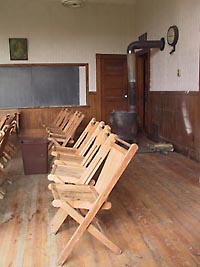
In the early years the children had to attend school in New Sweden, but about 1895 Jacob Jansson gave a parcel of land for a school. In 1908 the plantation began paying tuition for high school students. In 1922 they voted money for a new school, which has also served many other purposes over the years, including a town polling place. Before school conveyances, students from Blackstone were boarded with families nearer the school and students living near to a New Sweden school went there. But there was also a school situated on the road into Blackstone Siding, and probably a store in the area as well. It was of course not unusual for students to ski or walk considerable distances to school. Various types of covered horse-drawn sleds (with a stove inside) were used as conveyances in the winter. The plantation built its own horse-drawn snow plows and snow rollers, and later built its own truck-plows before buying a commercial plow in 1946.
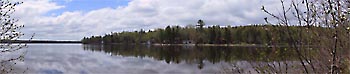
In 1958 it was decided to close the Westmanland School and send the students to New Sweden. Around 1957 camp lots were leased out along Little Madawaska Lake, about 33 from the paper company, 63 on "school land" from the State, with one public lot and a dam on Madawaska Stream. This has resulted in a moderate increase in development and population recently, with the camp owners now nearly outnumbering the residents of the farms, but most of the land in the township is still undeveloped and in the hands of the timber interests.
In 1977 the residents decided to become organized as the town of Westmanland.
Privacy Policy-We do not share contact information. Site comments, correcctions, and questions? No change is too small – email the official web guy: Bill Duncan, Bill@WilliamLDuncan.com ©2019 Site hosting courtesy of WilliamLDuncan.com. This site was originally developed with assistance of a Discovery Research grant from the Maine Arts Commission, the New Century Fund of the Maine Community Foundation and the historical societies of the Maine Swedish Colony.
Note, Dec 2019. This site is not updated on a regular basis. See individual historical society pages on Facebook for the latest.--Bill